
Undermining the Ideological Machinery of Patriarchal Culture
Critical Analysis • January 7, 2022An examination of feminist film theory, the male gaze, and the ways filmmakers like Maya Deren and Sally Potter challenge the patriarchal conventions embedded within dominant narrative cinema.
Undermining the Ideological Machinery of Patriarchal Culture — By Justin Andrew Schuck
Any discussion of the immeasurable impact of feminism on film studies must begin with Laura Mulvey. In her seminal essay, “Visual Pleasure and Narrative Cinema,” Mulvey weaponized psychoanalysis “in the battle for a critical consciousness caught in the ambush of Hollywood’s constraining and constricting representations of gender relations” (Villarejo and Tinkcom 9).
Mulvey’s intervention transformed feminist film criticism (of the sociological sort) into feminist film theory by casting a floodlight on the cinematic apparatus itself.
Feminist film theory examines the ideological foundations of sexual difference presented on screen by interrogating the sexual positioning of the spectator in terms of the psychic and social machinery of cinema.
“Visual Pleasure” was not merely an essay on film form, but a political manifesto that takes as its starting point “the way film reflects, reveals, and even plays on the straight, socially established interpretation of sexual difference which controls images, erotic ways of looking and spectacle” (Mulvey et al. 342).
The very technology of cinema functions to reproduce the ostensibly natural conditions of human perception through the conventions of dominant cinema demanded by realism. This combination of “naturalizing” conventions sutures the spectator into the narrative in a way that renders its ideological work invisible. The central aim of feminist film theory is to expose the patriarchal underpinnings of visual pleasure by recognizing the “male gaze” in order to reject its forms of cinematic and narrative pleasure. In this paper I will show how feminist film criticism uses psychoanalysis to deconstruct the narrative and representational forms of dominant cinema to overturn the ideological machinery of patriarchal culture. Any analysis of film would be incomplete—as it has been argued by feminist film theory for the last half century—without the necessary examination of the role that dominant cinema plays in upholding and naturalizing the structures of patriarchy.
Overthrowing the patriarchal ideology that suffuses dominant cinema necessitates an examination of how the language of the cinematic apparatus itself is organized around a precise and complex system that normalizes the conventions of Hollywood’s “invisible” style. Film technique is not neutral. Its narratological themes, methods of production (technical practices), and means of exhibition are a product of patriarchal ideology. Mulvey states that “the function of film is to reproduce as accurately as possible the so-called natural conditions of human perception” (Mulvey et al. 348). But, importantly, the images on screen do not depict reality, as Mulvey signals in her use of “so-called.” First, a phenomenological approach to studying film must examine how the cloak of the darkened cinema isolates perceptions by dulling the senses of the passive spectator—taking them temporarily out of their own reality—to coax them into identifying with the characters on screen. “There are three different looks associated with cinema: that of the camera as it records the profilmic event, that of the audience as it watches the final product, and that of the characters at each other within the screen illusion” (Mulvey et al. 352). The conventions of dominant cinema actively work to subordinate the first two to the third which obscures the presence of the camera in the name of cinematic realism. Second, typical Hollywood cinematic conventions work to create the illusion of reality by concealing the method of the film’s construction. “For example, a classic Hollywood film appears effortless to watch, offering a transparent ‘window’ onto its fictional world”—with the screen acting as a substitute for an actual window, casting the spectator in a captive voyeuristic role—“yet its ‘realism’ is created through the working of particular codes, such as the ‘invisible’ style of continuity editing, with its rules of the axis of action (180 degree rule), eye-line match, and 30 degree rule” (Chaudhuri 23). We have so internalized these codes that we do not even perceive them. We understand that camera angle changes of less than 30 degrees feel jarring, so, by avoiding this the spectator remains less aware of camera movements and the larger cinematic apparatus at work.
In dominant cinema, the male protagonist possesses the primary causal agency within the story—that is, they are the ones controlling the action—and thus are the locus for the audience’s identification. The suturing of the spectator into the filmic narrative is further reinforced by the eyeline match—a continuity editing technique that implies that the audience sees what the character sees—one of the most overused cinematic conventions. Nearly every narrative film ever made relies on this deceptively simple technique whereby the audience typically sees a wider shot showing a fuller picture of the male protagonist (the agent of the look) followed by a closeup of the woman who is the subject of his fetishizing gaze. Often she is fragmented, reduced to close-ups. Lighting further focuses the spectator’s attention to the woman within a mise-en-scène that serves to highlight her beauty, or, conversely, to magnify her villainy as in much of film noir (usually both). Cutting back again to the male character coaxes the spectator into identifying with him. Though the camera is ostensibly neutral, how the camera is deployed (by predominantly male filmmakers) is not. Patriarchy exists as a heavily naturalized system of social stratification which situates men at the top of a social hierarchy, though its ideology, or “theory of reality” remains (mostly) unconscious. Indeed, the codes of shot type and editing that reinforce and reproduce patriarchy are the invisible scaffolding of the endemic misogyny of narrative cinema, which Mulvey reveals in her feminist manifesto. The typical storyline of dominant cinema favors resolution and eschews ambiguity. There is nothing “real” about stories that have a “happy”ending where the man always gets his girl, or where the “whore” is punished for her transgressive behavior. So why is this such a repeated trope in dominant cinema?
Feminist film criticism wields psychoanalysis to cast a spotlight onto how the structures of dominant narrative cinema—its methods, codes, and narrative conventions—work to further a complex representational system that perpetuates patriarchal ideology through the repeated oppression of women. Psychoanalysis is a set of theories and therapeutic practices, founded by Sigmund Freud, that explore the unconscious mind. For Freud, the conscious mind is a smaller portion of our brain and is primarily concerned with what we do in our day to day lives—our thoughts and sense perceptions—while the unconscious mind refers to the latent desires and drives that influence our behaviors. The central aim of feminist film theory is to confront the ideological work of visual pleasure by delving into “the mechanisms of the unconscious, the myriad strategies upon which the male subject relies for fending off primary threats (posited in psychoanalysis as the threat of castration), including the replaying of defenses through the male-centered repetitive narratives of the movies” (Villarejo and Tinkcom 9). A key psychoanalytic concept that assists our understanding of how patriarchal structures and beliefs are produced is the myth of castration which children use to explain their understanding of biological sexual difference. Freud posited that “it is self-evident to a male child that a genital like his own is to be attributed to everyone he knows, and he cannot make its absence tally with his picture of these people” (Chaudhuri 20). Viewing women only in relation to the man through their lack of a phallus is entirely misogynistic, but that does not preclude psychoanalysis from its application in feminist film criticism. Quite the contrary.
For men this fear of castration relates to a fear of emasculation, the losing of their “rightful” male power, and this fear can only be overcome by either sadistic voyeurism (by punishing the woman) or by overvaluing her and subjecting her to fetishistic scopophilia (the pleasure of looking), thus denying her status as castrated.
This fetishistic scopophilia of the woman suspends the temporal narrative flow with the disavowal of her castration.
To be clear, “The scenario of fetishism is not about a real woman who lacks a real penis, but a structure in which symbolic relations, already constituted as meaningful, are put into play,” which is to say that seeing the image of “woman” on screen is not like looking at an actual “castrated” woman but rather seeing the structures of belief from that early psychic formation (Stam et al. 149). By mapping these early psychic formations to the formal cinematic structures that place the spectating subject in a voyeuristic position, looking but not seen, Mulvey shows how dominant cinema is cut to the measure of male desire, revealing the hidden machinations of patriarchal culture. “Visual Pleasure” uses feminist film theory to identify the fundamental contradiction in “woman” existing as the chief signifier of sexual difference through her clearly visible lack of a phallus—placed in the symbolic order underneath “man” to be the subject of his controlling gaze—and how she becomes the primary subject of erotic visual fixation. To escape this controlling gaze, women filmmakers have heeded Mulvey’s call for the creation of a counter-cinema that considers and refigures female subject positioning.
Notably, Mulvey links the rejection of dominant cinema’s “formal preoccupations [which] reflect the psychical obsessions of the society which produced it,” to the need for an “alternative cinema [that] must start specifically by reacting against these obsessions and assumptions” (Mulvey et al. 343).
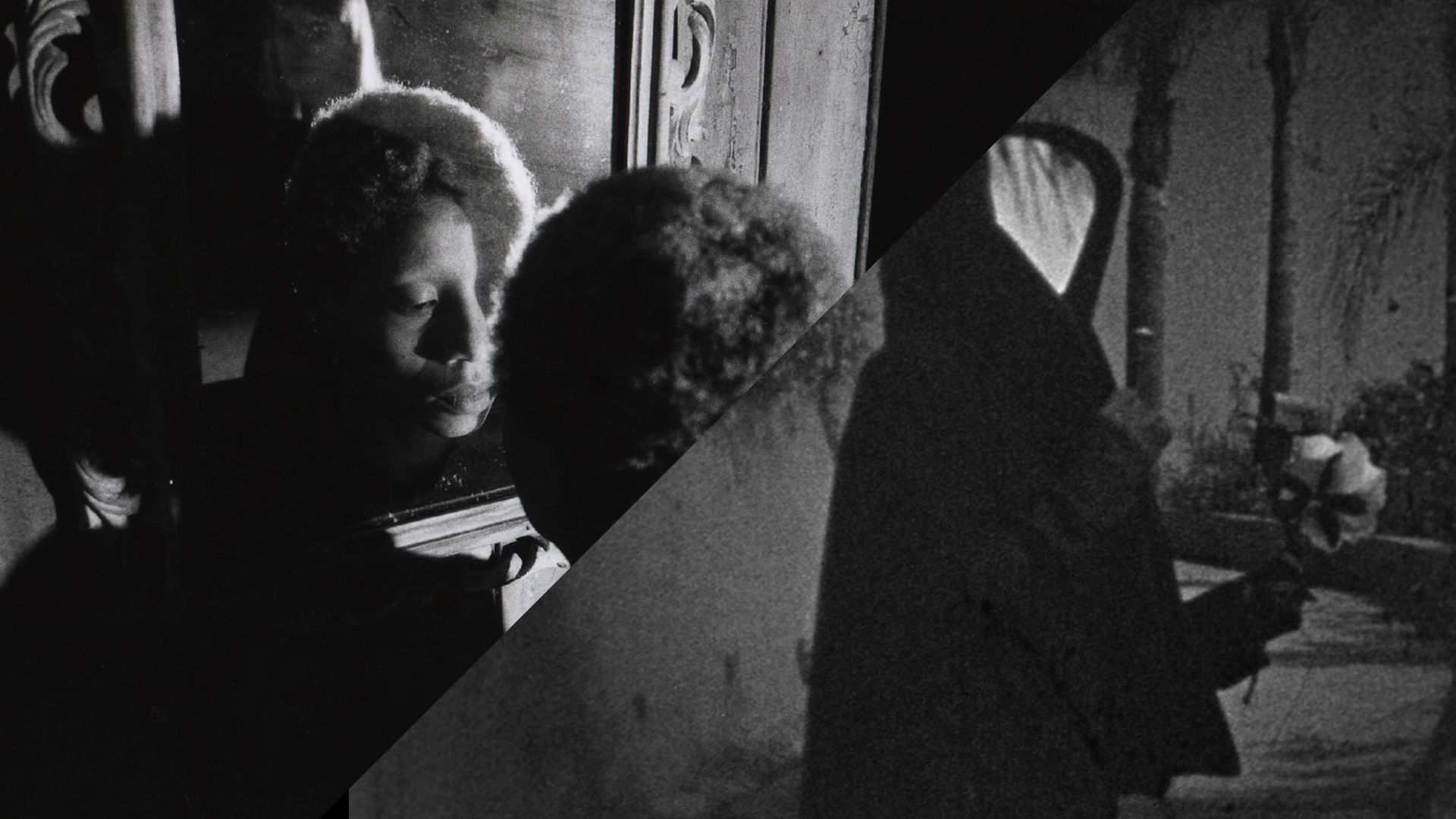
It is through this artificial naturalization of cinema that the myth of “woman”—constructed only in her relation to a man—transmits and transforms the ideology of sexism into something imperceptible. Thus, feminist counter-cinema starts by exposing this ruse. While Maya Deren’s film, Meshes of the Afternoon (1943), predates “Visual Pleasure” by thirty-two years, Deren noted how narrative cinema appeals to the “latent Peeping Tom in the audience” (Geller 149). Preceding the advent of feminist film theory by several decades, Deren called attention to how the conventions of narrative cinema posited the spectator as voyeur. In the opening shot of Meshes, a mannequin hand holding a paper flower is lowered into the frame, immediately challenging cinema’s representation of the human form: “We, like the infant, see only a fragment of the female body—her arm,” and like an infant who only knows the mother “through the metonymical experiences of her—her arm entering the crib—the arm is seen as an object” (Geller 143). When the mannequin arm disappears without a trace, “the film brings to the surface the most startling experiences of the infant in the Imaginary by calling the spectator’s attention to the more frightening aspects of loss and alienation that dominant cinema works maniacally to efface through the fullness of the screen image—and particularly the fetishization of the female” (Geller 143).
The dream sequence that structures much of the film is introduced by a closeup of Deren’s eye, engaging in the rapid eye movement (REM) sleep that is typically where most dreaming occurs. The dream sequence “signifies an interior psychic space (‘I’)—the realm of the unconscious,” where the initial experience of castration has been repressed (Geller 144). Deren commences to repeat the cycle of chasing an elusive mirror-faced character evoking the psychoanalytic notion of the mirror-stage. “The mirror phase,” which is key element of Mulvey’s attack on narrative cinema, “occurs at a time when the child’s physical ambitions outstrip his motor capacity, with the result that his recognition of himself is joyous in that he imagines his mirror image to be more complete, more perfect that [how] he experiences his own body” (Mulvey et al. 345). Yet, in Deren’s film, not only does the mirrored other evade capture, it also fails to reflect Deren’s image, implying the inability of the mirror—and by extension, the film screen—to reflect back Woman’s subjectivity. Through the employment of counter-cinema techniques, Deren deconstructs the artificial naturalization of dominant narrative cinema demanded by realism.
“Film does not reflect or even record reality.”
-Graeme Turner“Film does not reflect or even record reality,” Graeme Turner writes, “like any other medium of representation it constructs and ‘re-presents’ its picture of reality by way of the codes, conventions, myths, and ideologies of its culture as well as by the way of the specific signifying practices of the medium” (178). Meshes and Sally Potter’s film, Thriller (1980), shatters these codes by employing counter-cinema techniques that refuse cinema’s implicit “realism” entirely. In Thriller, Potter deconstructs Puccini’s classic nineteenth century melodrama, La Bohème, to investigate how classic patriarchal texts exploit the heroine. Potter further exposes the repression of female subjectivity by her (Mimi II) reflection on the reasons for her death through extra-diegetic narration meant to signify internal thought processes. But, even before the story begins, Potter undermines the spectatorial expectations created by dominant cinema by holding the spectator in an uncomfortable suspension before a black screen for an inordinately long period of time, drawing attention to the conceit of the film artifice. As the audience awaits the appearance of an image on screen, there is an expectation that a three-act narrative with a clearly defined beginning, middle and neatly-wrapped end will soon commence. But no such story ever arrives. Instead, the circumstances of Mimi I’s death are deconstructed in the deliberately “frozen” space.
Potter’s incorporation of still images of a theatrical production on the opera stage “reflects traditional realist conventions which places figures in the proscenium arch at eye level, in medium-long shot, and create an illusionist [and] representational mise-en-scène within which actors and objects are harmoniously arranged” (Kaplan 156). Like Deren’s unreflective and ultimately shattered mirror, Potter underscores the impossibility of change and lack of agency afforded female subjects in dominant narrative structures. Thriller’s mise-en-scène—with its curtainless windows and the open door through which nothing can be seen—further represents the physical literalization of the psychical exploration Potter raises in her narration. Nothing about this conforms to any notion of how dominant cinema creates the illusion of realism, and that’s the point. Thriller exemplifies the counter-cinema necessary to privilege the female subject, to understand her role within the narrative structure, and to undermine the scaffolding of dominant cinema by deconstructing myths about the “woman.”
By weaponizing psychoanalysis, Mulvey reminds us that to take account of the role that films play in the production of meaning without consideration for female subject positioning is to ignore the ideological function of narrative, realism and the cinematic apparatus, and the consequences of such an account. “Ultimately, Mulvey calls upon us (intellectuals, filmmakers) to convert passive pleasure into both critical acumen and a counter-cinema'' (Villarejo and Tinkcom 9). The examples of experimental films made by women—albeit forty years apart—show how Mulvey was far from alone in her condemnation of the patriarchal unconscious of narrative cinema. Deren’s self-reflexive film takes aim at the fetishistic tendencies of dominant film form, while Potter’s haunting repurposing of the staccato score from Alfred Hitchcock’s film, Psycho (1960), targets the more sadistic side of the psychical obsessions of the patriarchal society which depend on woman’s castration as the bearer of meaning. By flipping the table on the ideological structures of patriarchy that serve as the foundation for dominant narrative cinema, both films use feminist counter-cinema practices to cleave an opening for the female spectator’s visual pleasure, untethered to whims of the controlling male gaze.
Works Cited
Chaudhuri, Shohini. “Beginnings.” Feminist Film Theorists Laura Mulvey, Kaja Silverman,
Teresa De Lauretis, Barbara Creed, Routledge, London, 2006, pp. 15–29.
Deren, Maya and Alexander Hammid, directors. Meshes of the Afternoon. 1943.
Geller, Theresa L. “The Personal Cinema of Maya Deren: Meshes of the Afternoon and Its Critical Reception in the History of the Avant-Garde.” Biography, vol. 29, no. 1, 2006, pp. 140–158., https://doi.org/10.1353/bio.2006.0021.
Hitchcock, Alfred, director. Psycho. 1960.
Kaplan, E. Ann. Women and Film: Both Sides of the Camera. Routledge, 1983.
Mulvey, Laura, et al. “Visual Pleasure and Narrative Cinema.” Media and Cultural Studies: Keyworks, Revised Edition ed., Blackwell Publishing, Oxford, UK, 2006, pp. 342–352.
Nichols, Bill. Movies and Methods: An Anthology: Vol.II. University of California Press, 1985.
Potter, Sally, director. Thriller. 1980.
Stam, Robert, et al. New Vocabularies in Film Semiotics: Structuralism, Post-Structuralism and Beyond. Routledge, 1992.
Turner, Graeme. Film as Social Practice. Routledge, 2009.
Villarejo, Amy, and Matthew Tinkcom. Keyframes Popular Cinema and Cultural Studies. Taylor & Francis e-Library, 2003.
Williams, Linda. Figures of Desire: A Theory and Analysis of Surrealist Film. University of California Press, 1992.